Author: Deng Bochen / Senior Media Worker
The cultivation of outstanding artists, the inheritance of national historical culture, the influence of the era in which they were born and lived, and their personal innate qualities are all indispensable. In the modern Taiwanese art scene, those who can embody all three and establish their own school, the master without a doubt is Zhao Zhan'ao.
As for Taiwan, since the Nationalist government's relocation to Taiwan, under the conflict and integration of Chinese tradition and Western modernity, the most notable and extraordinary achievement in the Taiwanese art scene has been the rise of modern ink or abstract ink, which not only attracted Western attention but also, through multiple interactions across the strait, flowed back to influence the original home of ink painting in mainland China. In the early 1960s, led by the emerging artist Liu Guosong (1932-), Taiwan's abstract ink began to flourish. Liu Guosong criticized the Japanese gouache painting as "heavily made up for the dead" and traditional ink as "like dead specimens nailed to the wall," advocating for a return to the world of paper and brush ink in pursuit of "modern Chinese painting," pushing abstract ink to its peak.
During this period, Zhao Zhan'ao, who specialized in oil painting, secluded himself in the southern tip of Taiwan, effectively isolated from the world, and did not begin his ink creations until 1973, by which time Taiwan's modern painting movement was nearing its end. Nevertheless, in 2004, the Executive Yuan's Cultural Construction Committee published "Taiwan Modern Art Series - Ink Category: Abstract Lyric Ink," written by renowned Taiwanese art historian Hsiao Ching-jui, introducing twelve outstanding artists led by Liu Guosong, with Zhao Zhan'ao prominently listed! Although he started more than ten years late, his late arrival was able to stand shoulder to shoulder, demonstrating his potential and explosive power.
However, what is particularly different is that Zhao Zhan'ao is not confined to the realm of abstract ink. In fact, in Taiwan, he is an extremely rare dual-genre artist, straddling both ink and oil painting. What is even more remarkable is that in these two seemingly incompatible fields, he balances both figurative and abstract styles, like a single person mastering four steeds, galloping across a vast artistic landscape, freely navigating the realms of Eastern and Western painting, with ease and continuous creation until his death, even Lin Fengmian and Wu Guanzhong would have to give him some credit!
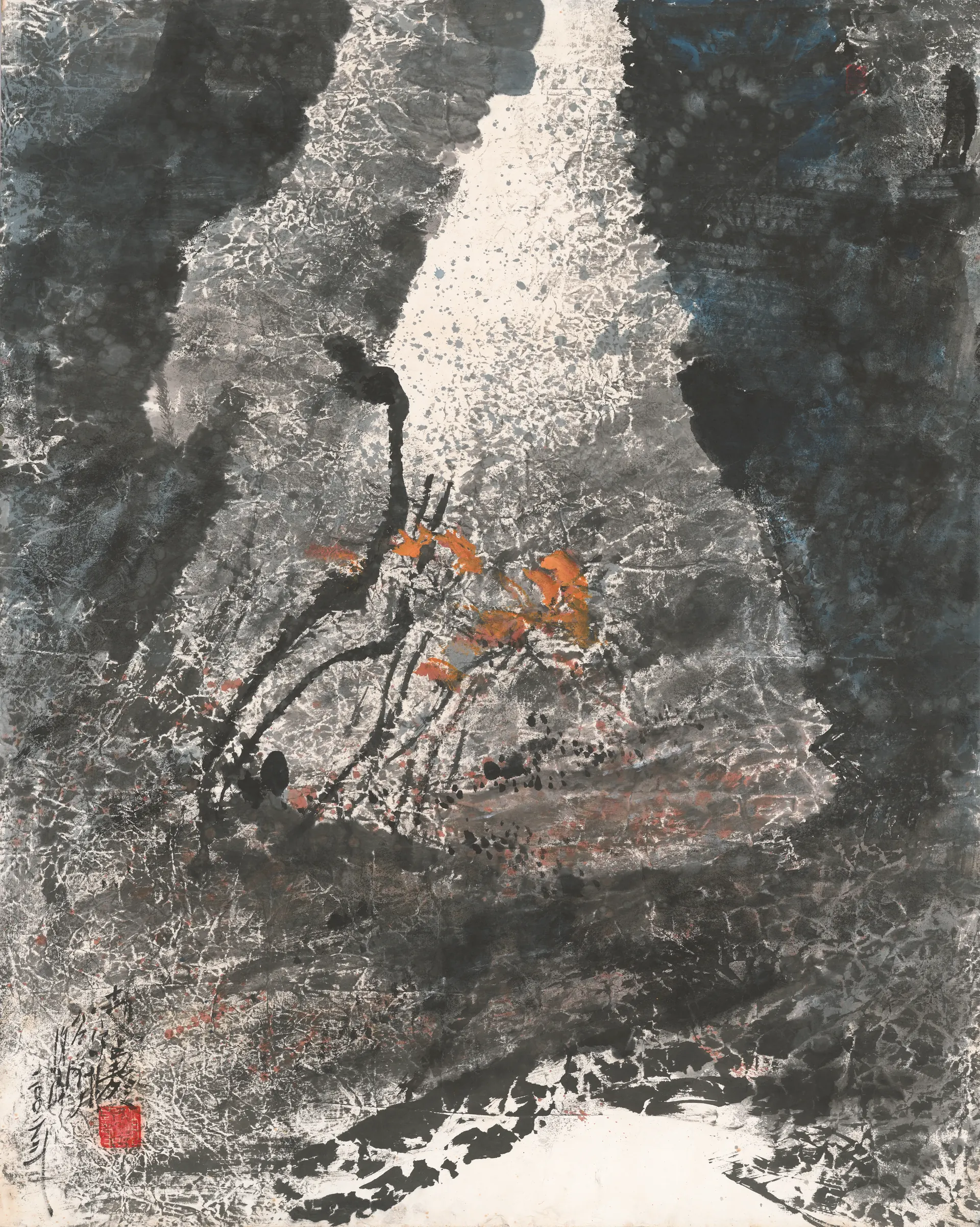
Following Lin Kegong (1901-1992) to study oil painting in England, Zhao Zhan'ao quickly emerged, winning the international women's association art competition in the oil painting category, being selected for the São Paulo Biennial in Brazil, and graduating with first-class honors in 1962, remaining at the school as a teaching assistant. That year, Zhao Zhan'ao turned thirty. It was also the year when Liu Guosong, born in the same year as Zhao Zhan'ao, sounded the clarion call for modern ink in Taiwan.
The cultivation of outstanding artists, the inheritance of national historical culture, the influence of the era in which they were born and lived, and their personal innate qualities are all indispensable. In the modern Taiwanese art scene, those who can embody all three and establish their own school, the master without a doubt is Zhao Zhan'ao.
After specializing in oil painting for over ten years, with works already recognized both domestically and internationally, Zhao Zhan'ao suddenly picked up the traditional brush to create ink paintings, and moreover, abstract ink, which was by no means accidental, but rather a necessity and inevitability. In 1985, he held his first ink painting exhibition, and his unique style immediately attracted high attention and received high praise. When asked about the reason for this transformation, he stated:
"I feel that this allows me to release myself more and express myself."
The return to the roots of ink and the artistic path of East-West fusion
Zhao Zhan'ao once experienced upheaval and poverty, and because of this, even in later stable years, he never relaxed in his pursuit of art. He was also a person of intense emotions, and his fulfilling love with his wife Cheng Liuling allowed him to devote himself entirely to artistic creation without worries. However, he could not resist the call of his homeland. After the cross-strait opening, he returned to his hometown, reminiscing about his ancestors and reliving his youthful wanderings, eventually settling in Qingdao.
What he found particularly irresistible was the majestic mountains and rivers of his homeland. He learned from Shitao to "sketch drafts by searching for extraordinary peaks," accepting the revelations of nature, traversing South China, Central China, North China, Northeast China, and even Xinjiang, brewing his "prototype" in his heart. He believed that nature always takes the initiative; it is not we who choose to open nature, but when we are ready, nature chooses to open us. Once the prototype is formed, he would close the door to create, allowing the overwhelming energy within him to spill onto the paper. Speaking of his works, he said: "Whether it is local scenery or the landscapes of the mainland, they are all personal experiences, derived from spiritual experiences, and their artistic conception is not something ordinary sketches can pursue." He is not a sketch artist but a "landscape creator."
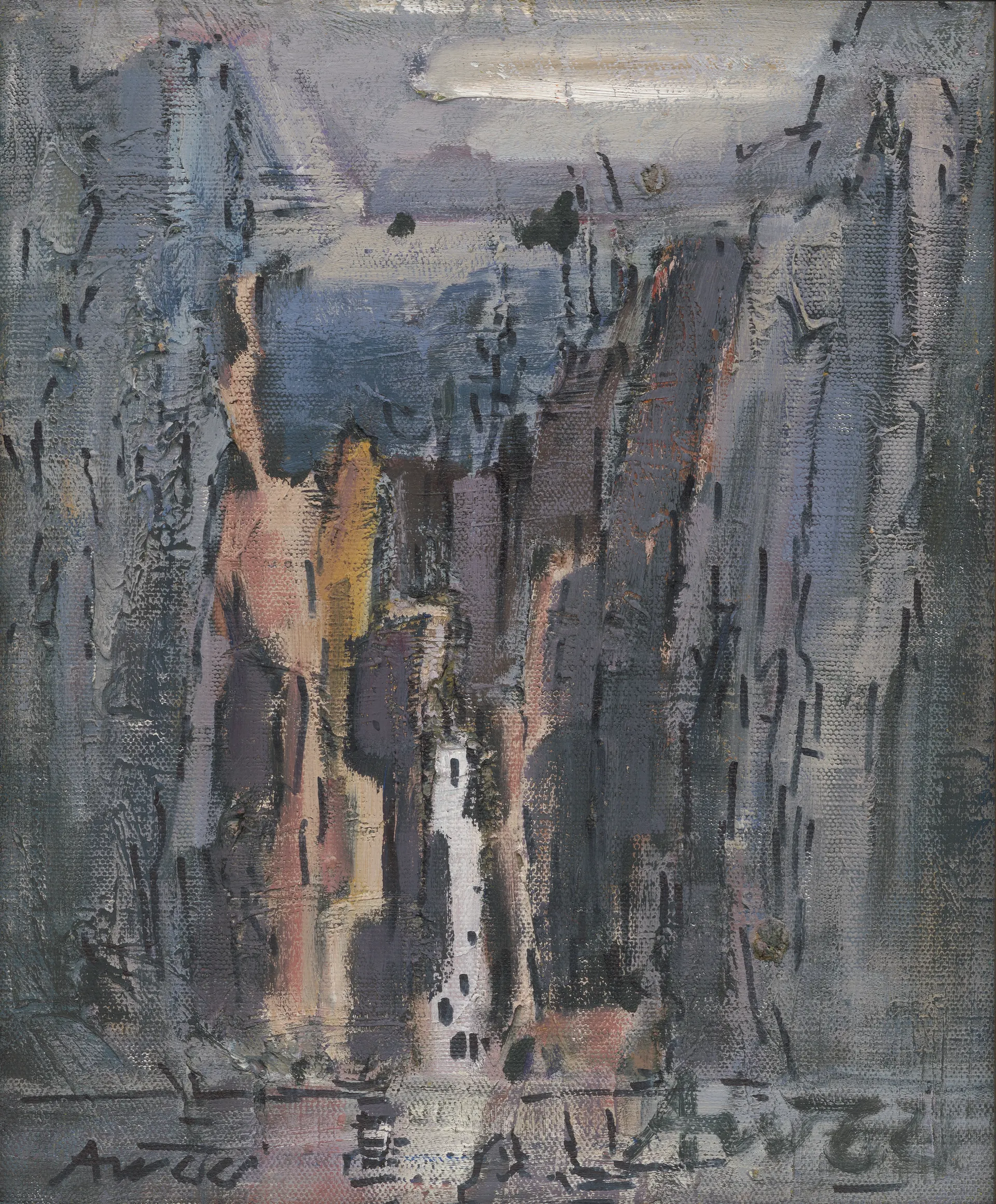
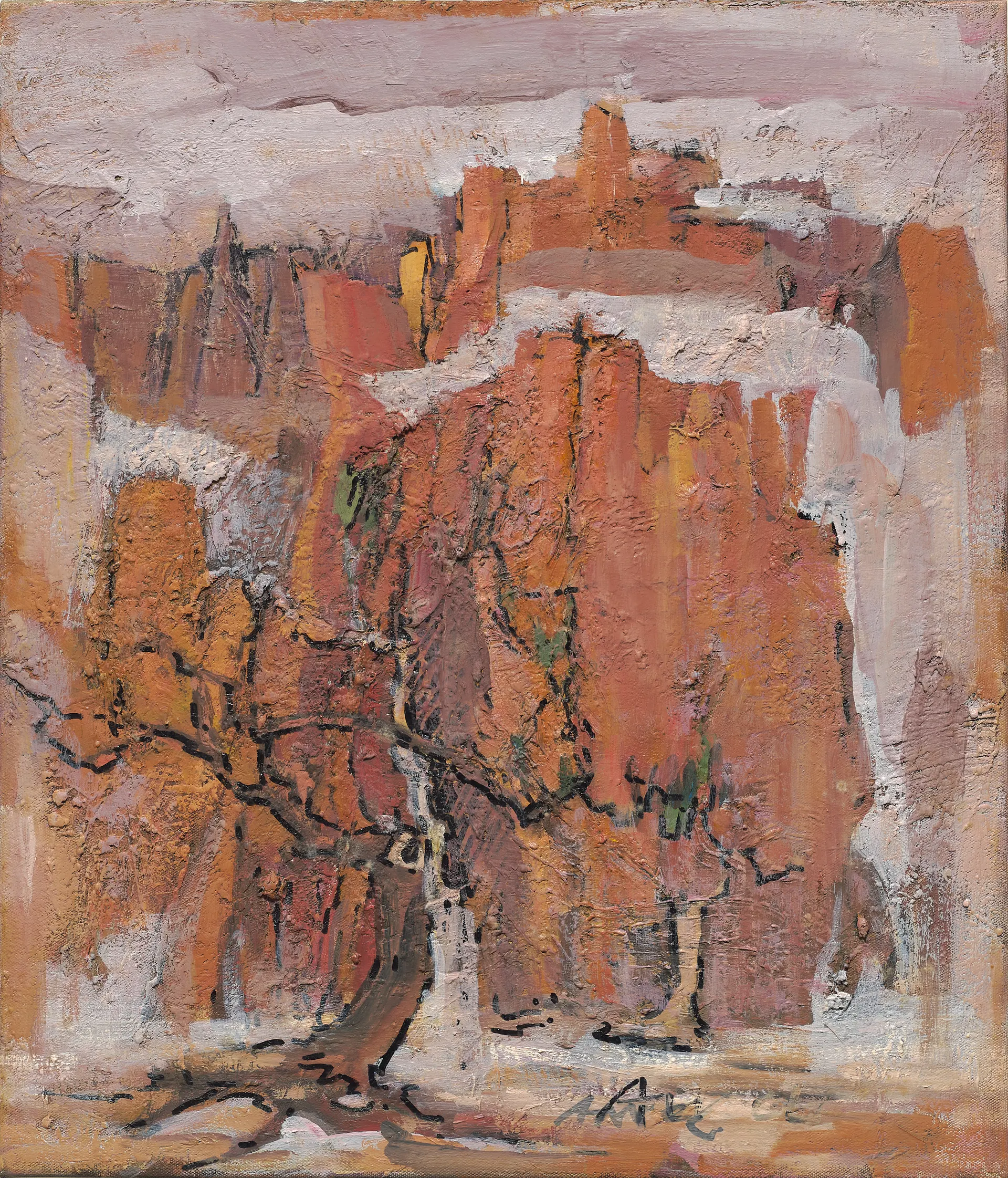
Unlike his most admired artist Picasso, Zhao Zhan'ao's paintings cannot be categorized by period; the key lies in his attitude towards painting. "My attitude is present; each painting has a prototype, and I never repeat," Zhao Zhan'ao said. In fact, this prototype includes not only the subjects, images, and artistic conceptions he wants to express but also the methods and styles of expression. In other words, his prototype determines the expression: Zhao Zhan'ao of abstract ink, Zhao Zhan'ao of expressive ink, Zhao Zhan'ao of abstract oil, Zhao Zhan'ao of expressive oil, regardless of time or period, wandering in his artistic world, this has been the case throughout his life. This is also what distinguishes Zhao Zhan'ao from other artists; his painting style is diverse and unconstrained, not bound by time. More importantly, his four styles have also been changing; for example, after entering the 21st century, his ink paintings have shifted towards cooler tones, exuding tranquility, composure, and depth, vastly different from the earlier intense warm tones of passion, anxiety, and wildness. Similarly, his abstract oil paintings in his later years resemble reliefs affixed to the canvas, resembling towering rock walls, solemn and majestic.
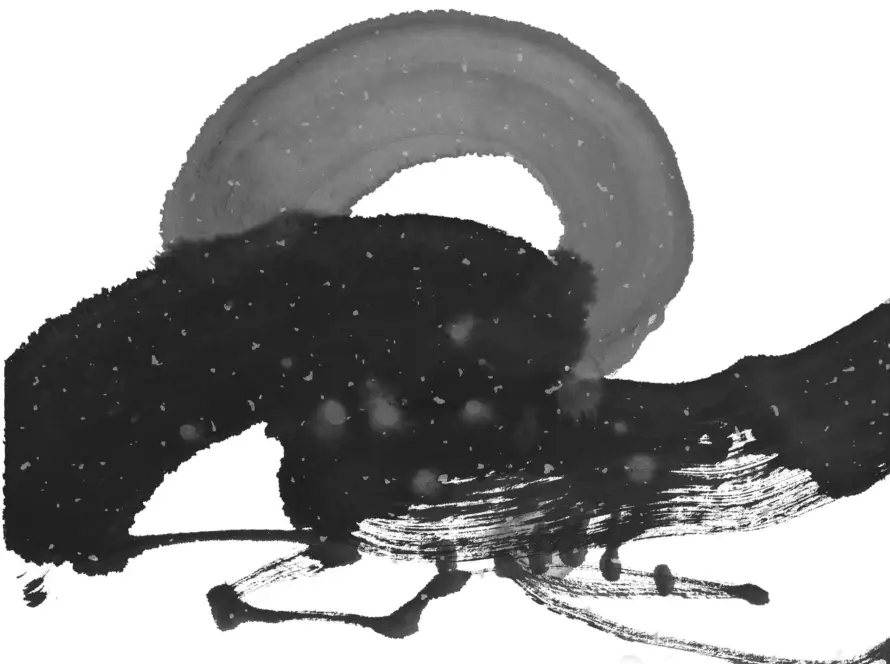
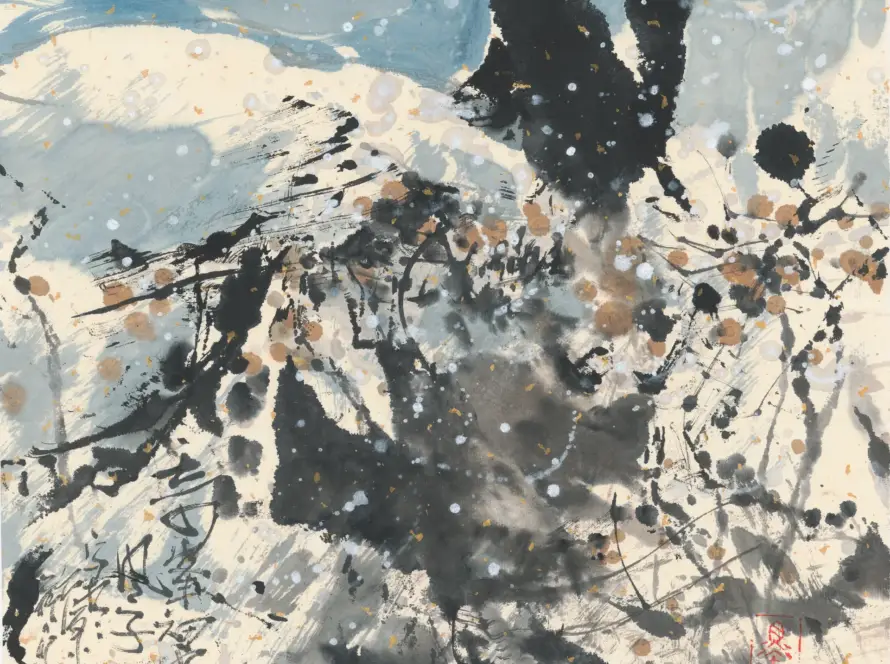
In terms of composition, Zhao Zhan'ao created a brand new layout for Chinese ink painting. He uses the small to represent the large, expressing the whole through parts, presenting a unified image that forms its own universe. Although the structure is complex, with multiple layers, intersecting lines, scattered ink spots, and a riot of colors, seemingly chaotic, there is always a force, whether strong or weak, that gathers the various elements visible to the eye into a whole where form and meaning are seamlessly integrated, conveying a feeling that can be sensed and immersed in, with an infectious artistic conception that makes one feel as if they are part of it.
Similarly, in terms of color, he has also broken through traditional boundaries. The duet of color and ink: he elevates color to a status equal to ink, with no distinction between guest and host. Large areas of ink and large areas of color either chase each other or stand in opposition, independent yet unified. Warm colors are strong and eye-catching, seemingly eager to surpass ink and soar, exuding wildness, unruliness, release, tension, and anxiety; cool colors are understated and calm, blending and diffusing with ink, presenting elegance, comfort, antiquity, and depth. In ink painting, Zhao Zhan'ao swept away the function of color as a mere aid to ink, endowing color with a brand new meaning!
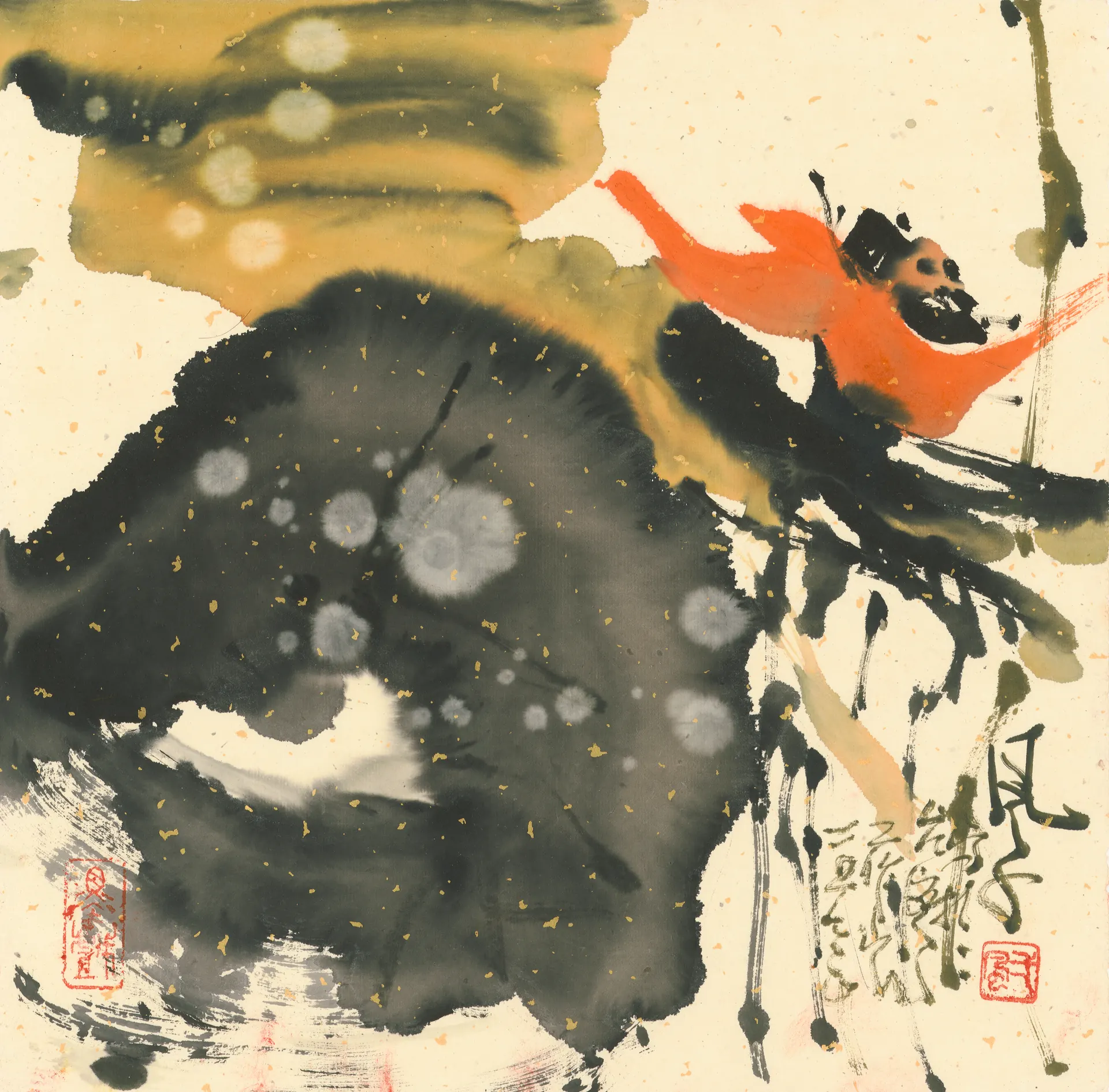
A true artist lives for art, and the final energy of life must also be poured into creation.
In 2015, he was diagnosed with stomach cancer and underwent surgery to remove two-thirds of his stomach, leaving him extremely weak, forcing him to temporarily set aside his creations. However, his desire to create never diminished; he published two photography collections "Neither Color nor Ink" - the beauty of the shedding of French sycamore bark, where each photo is a work etched by life, with thick color blocks, saturated hues, rich layers, delicate textures, and lines intertwining and swirling, sometimes diving deep, embedding in color blocks, sometimes jumping out, surfacing on the color surface, with layouts that leave no trace and structures that seem to exist and not exist, a perfect replica of Zhao Zhan'ao's abstract oil. He said: "This is simply me!" The artist discovered himself in nature, and his excitement was palpable.
In 2018 and 2019, despite his illness, Zhao Zhan'ao launched his final sprint in artistic creation, painting over one hundred and fifty small ink pieces in less than two years, each one flowing with ink and color, reaching the realm of expressive abstraction, truly his best works. Notably, all these small pieces were signed not with his real name but as "Fengzi," a homophone for "crazy person." He was obsessed with art and crazy about painting, saying: "Fengzi, Fengzi, Zhao the crazy person!"
Additionally, there are dozens of small oil paintings, each with a base color already laid down, but unfortunately, time did not allow for their completion. Zhao Zhan'ao regarded art as his primary life; in his youth, he vowed to release himself in artistic creation, to break free from the West and surpass the ancients. He achieved it! This article is dedicated to paying tribute to the master.
More details
About Chan-Ao Chao
Chronology
Artistic Positioning
Press